
If you’ve ever Googled “what does an executive assistant do,” you’re probably at a crossroads.
Maybe you’re drowning in admin work and wondering if an EA is the answer. Maybe you’ve heard the term thrown around but aren’t sure how it’s different from a regular assistant or a virtual assistant. Or maybe you’ve tried hiring help before and it didn’t work, and you’re trying to figure out why.
This article breaks it all down. What an executive assistant actually does, what separates a good one from a great one, and how to know if you’re ready for one.The Short Answer
An executive assistant supports a senior leader — typically a founder, CEO, or executive — by managing the operational and administrative work that would otherwise consume that leader’s time and attention.
But that definition undersells the role significantly.
A great executive assistant doesn’t just take tasks off your plate. They protect your time, anticipate your needs, and become a trusted operational partner who makes your entire leadership function more effective.
What an Executive Assistant Actually Does
The day-to-day responsibilities of an executive assistant vary depending on the leader they support and the business they work in. But most EA roles cover some combination of the following:
Calendar & Scheduling Management An EA owns your calendar. They schedule meetings, manage conflicts, coordinate across time zones, block focus time, and make sure you’re never double-booked or walking into a call unprepared. For many founders, this alone is worth the hire.
Email & Communication Management A great EA triages your inbox so you only see what actually needs your attention. They draft replies, follow up on unanswered threads, and make sure nothing important falls through the cracks.
Meeting Preparation & Follow-Up Before a meeting, your EA prepares an agenda and briefs you on who you’re talking to and what needs to happen. After the meeting, they capture action items, distribute notes, and follow up on any commitments made.
Travel & Logistics Coordination From booking flights and hotels to building detailed itineraries, an EA handles the full logistics of business travel so you can focus on why you’re traveling, not the mechanics of getting there.
Task & Project Coordination An EA keeps track of open tasks across your team, follows up on deliverables, updates project management tools, and makes sure nothing stalls because someone forgot to send a follow-up.
Research & Preparation Need to know who you’re meeting with? Want a competitive analysis before a key decision? Your EA handles the research and packages it into a clear, usable summary.
Document & File Management Formatting decks, organizing shared drives, preparing reports, and maintaining internal documentation… an EA keeps your operational infrastructure clean and accessible.
Vendor & Stakeholder Coordination An EA can manage relationships with contractors, vendors, and service providers on your behalf — handling communication, follow-ups, and contract administration.
Personal & Executive Support Many EAs also support leaders with personal logistics — booking appointments, managing gift lists, coordinating events, and handling the personal coordination that quietly eats into a founder’s day.
What an Executive Assistant Is Not
This is where a lot of founders get confused, and where a lot of hires go wrong.
An executive assistant is not a virtual assistant.
A virtual assistant typically handles specific, task-based work on an as-needed basis. They’re often working across multiple clients simultaneously and are not deeply embedded in your workflow.
An executive assistant is embedded. They understand your priorities, your communication style, your calendar, your stakeholders, and how you make decisions. Over time, they stop reacting to your requests and start anticipating your needs.
That’s a fundamentally different relationship, and it requires a fundamentally different approach to hiring and onboarding.
The Real Value of a Great Executive Assistant
The tasks above are important. But the real value of a great EA is harder to quantify.
It’s the mental space you get back when you’re not tracking 40 open threads in your head. It’s the leadership capacity that returns when you’re not spending two hours a day on coordination. It’s the strategic conversations you can finally have because your calendar isn’t running your week.
Founders who have built strong EA partnerships consistently describe the same shift: they go from feeling like an operator buried in their own business to feeling like a leader who is actually driving it.
“What stood out was the level of structure. It wasn’t just about hiring an assistant — it was about making sure the partnership actually worked.” — Compass Point Client, E-commerce Business Owner
Why Most EA Hires Fail
If the role is so valuable, why do so many founders try it and give up?
The answer almost always comes down to structure, or the lack of it.
Most executive assistant hires fail not because the person wasn’t capable, but because the onboarding was rushed, expectations were never clearly defined, and there was no system to support the relationship after the hire.
The founder gets frustrated. The assistant gets confused. Within 60 days, the work is back on the founder’s plate and the hire is written off as a mistake.
This is not a talent problem. It’s a system problem.
How Compass Point Does It Differently
At Compass Point, we don’t just place executive assistants. We build the infrastructure that makes the placement succeed.
Our Compass 90™ framework is a structured 90-day onboarding and integration process that covers workflow mapping, communication standards, delegation protocols, and progressive task handoff, so the EA doesn’t just get hired, they get embedded.
Beyond placement, we provide ongoing support through Compass Quarterly™ performance reviews and Compass 360™ retention management, because the goal isn’t a successful hire on day one. It’s a trusted partnership that lasts.
Is an Executive Assistant Right for You?
If you’re spending more than two hours a day on tasks that don’t require your specific expertise as a leader, scheduling, inbox management, follow-ups, coordination… the answer is probably yes.
A few questions worth asking yourself:
- Are you still managing your own calendar?
- Do you regularly defer strategic work because operations won’t stop?
- Have you tried to delegate before and pulled the work back?
- Would 10 extra hours per week change what you could accomplish?
If you answered yes to two or more of those, it’s worth having a conversation.
Ready to Find Your Executive Assistant?
Compass Point is a managed executive assistant placement partner for growth-stage founders and executives in the US. We recruit, place, and integrate high-quality EAs through our structured Compass 90™ framework, so the right person doesn’t just get hired, they stick.
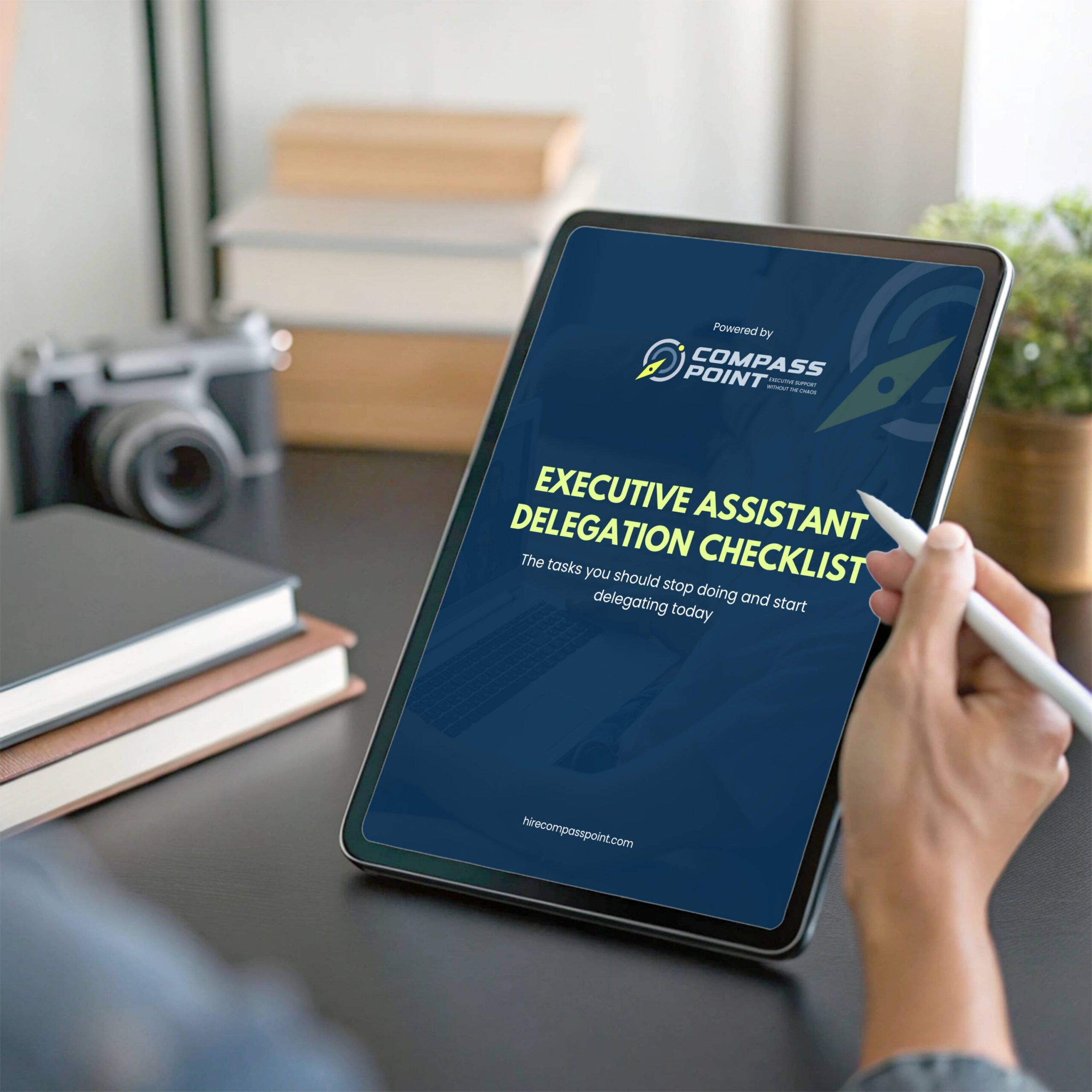
Download our free EA Delegation Checklist to see exactly which tasks you should be handing off, or reach out to schedule a Strategy Call at hirecompasspoint.com.